If you and I both run 8-minute pace, but I'm using less oxygen and less energy to do it, I'm more economical. Over a 5K, half marathon, or marathon, that gap adds up in a big way. And here's the thing most runners don't realize: the strength training you're already doing might not be the kind that actually improves your economy. Here's what a 2024 study found, and how it may impact your training next week.
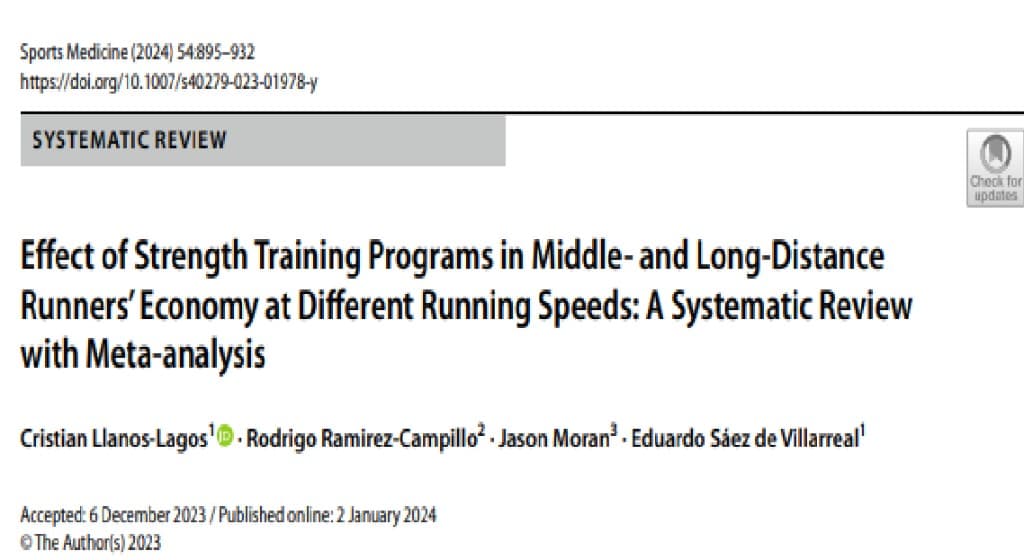
The full study is here: Llanos-Lagos et al. (2024) in Sports Medicine (PDF). This article is that newsletter, expanded with the numbers and methods from the paper itself.
Not sure where to start? The free Runner Strength Screen takes 15 minutes at home and shows you which links in your chain are weakest before you build a program.
The Research
A 2024 systematic review in Sports Medicine pulled together 31 studies and 652 middle- and long-distance runners to answer a question that's more nuanced than it sounds: not just whether strength training running economy improves, but which type of strength training helps, and at which running speeds. That distinction matters more than most people realize2.
Running economy is simply the energy you burn to hold a given pace. It sits alongside VO2max and lactate threshold as one of the best predictors of distance performance1. Two runners with the same aerobic engine can race very differently if one runs more efficiently7.
What They Found
The research suggests these are the key takeaways:
- Combining heavy lifting and plyometrics produced the largest improvements in running economy, across speeds of 6:45–9:40 per mile (10.0–14.45 km/h in the paper)
- Heavy load training (at or above 80% of your one rep max) improved running economy across a wide range of speeds, 5:25 to 11:05 per mile, and became increasingly effective as speed and fitness level increased
- Plyometric training improved economy specifically at paces around 8-minute mile or slower (≤12 km/h) but showed no significant benefit at faster speeds when all test speeds were pooled together
- Submaximal load training (light to moderate weights) and isometric training showed no significant improvement under any conditions tested
- Minimum effective program length was 6 weeks, with 2 to 3 sessions per week
Worth noting: sample sizes across individual studies were small and protocols varied a lot, so there is no single perfect program proven here. These are patterns, not prescriptions.
Inside the Study (For the Research-Curious)
If you want to see exactly how the authors got to those takeaways, here is the walk-through. The protocol was pre-registered on the Open Science Framework and the review followed PRISMA2.
How They Found and Filtered Studies
The search team screened 1,749 records from PubMed, Web of Science, Scopus, and SPORTDiscus (updated through November 2022). After duplicates and exclusions, 73 full texts were reviewed. 42 were cut for reasons like: no control group, no running economy outcome, wrong population (under 16 or injured), or ineligible training (core-only, isokinetic-only, etc.).
31 studies made the final meta-analysis. That PRISMA funnel is worth remembering: this is not "31 random gym studies." It is the subset that met strict PICOS criteria.
Who Was Studied (and How They Were Classified)
The pooled sample: 652 runners, age 17–45, mean body mass 68.5 kg2:
| Training level | Runners (n) | VO2max cutoffs used in the paper |
|---|---|---|
| Moderately trained | 195 | Males ≤55, females ≤45 ml/kg/min |
| Well trained | 272 | Males 55–65, females 45–55 |
| Highly trained | 185 | Males ≥65, females ≥55 |
Sex balance was skewed: 472 males vs 180 females. Most individual trials were small. The authors used a three-level meta-analysis so studies that tested running economy at multiple speeds (common in this literature) did not have to throw away data or double-count runners incorrectly.
Interventions lasted 6–24 weeks, 1–4 sessions per week, added to (or partially substituted for) normal endurance running. Minimum intervention length was 3 weeks for inclusion; pooled programs started at 6 weeks.
The Five Training Types (Defined Exactly as in the Paper)
The authors classified every program into one of five buckets:
- Heavy load (HL): ≥80% 1RM (≤7 reps), aimed at maximal force (squats, deadlifts, etc.)
- Submaximal load (SL): 40–79% 1RM (8–20 reps), moderate gym work
- Plyometric (PL): <40% 1RM, explosive work targeting the stretch-shortening cycle (drop jumps, hops, bounds)
- Isometric (ISO): static holds (often ankle plantarflexion in the included trials)
- Combined methods: two or more of the above in one program (e.g., HL + PL in the same session = "complex training")
Controls were runners who kept endurance training but did no strength work, or only very light loads (<40% 1RM).
Running economy was measured as energy cost at submaximal speed (calories or oxygen). When both were reported, the authors preferred calories because it accounts for substrate use. They collected economy at every speed each study reported, from 7.00 to 18.00 km/h, then analyzed 80 effect sizes across those speeds.
What the Statistics Say (Behind the Takeaways Above)
The authors used Hedges' g effect sizes. Negative g means the strength group used less energy at the same speed than control. Small, moderate, and large effects were defined as 0.15, 0.45, and 0.802.
Heavy Load Training: 11 Studies, 19 Effect Sizes
Main result: small significant improvement, g = −0.266 (95% CI −0.516 to −0.015), p = 0.039, across speeds 8.64–17.85 km/h (roughly 5:25–11:05 min/mile)2.
That matches the newsletter line about heavy load helping more as speed and fitness increase:
- Faster test speed → larger benefit (β = −0.117 per km/h, p = 0.027)
- Higher baseline VO2max → larger benefit (β = −0.040 per ml/kg/min, p = 0.020)
Programs in the HL pool ran 6–14 weeks, typically 2–4 days per week. Squats, deadlifts, split squats, calf raises, and leg press appeared repeatedly.
Plyometric Training: 11 Studies, 28 Effect Sizes (Read This Carefully)
Main pooled result: no significant effect, g = −0.122, p = 0.167 across all speeds from 7.00–18.00 km/h2.
That surprises people who only read abstracts. Plyometrics did not beat control when every test speed was thrown together.
Subgroup at ≤12.00 km/h (~8:00/mile or slower): g = −0.307, p = 0.028 (small significant effect). Above 12 km/h, the moderation went the other direction (β = 0.470, p = 0.017): plyos were less effective when economy was measured at faster speeds.
The authors explain this with biomechanics: at slower speeds, longer ground contact gives tendons more time to store and return elastic energy. At faster speeds, tendon mechanics and raw force production matter more, which favors heavy load work.
That is why the practical split below (plyos at 8:00/mile or slower, heavy load above) is not guesswork. It is what this paper's speed moderation analysis actually reported.
Combined Methods: 9 Studies, 20 Effect Sizes
First pass (with outliers): moderate effect g = −0.647, p = 0.013, but heterogeneity was significant.
After removing outlier data points (including Paavolainen et al. and one 16 km/h cell from Li et al.), the authors report g = −0.426, p = 0.018, at speeds 10.00–14.45 km/h (~6:45–9:40/mile)2. That is the 0.43 moderate effect in the chart above.
Nearly all combined programs included heavy load and/or plyometrics. Several also included submaximal work, which alone did not work (see below). The authors hypothesize HL and PL adaptations stack when programmed together (complex sessions: heavy exercise followed by explosive work in the same workout).
Submaximal Load Training: Only 3 Studies, 7 Effect Sizes
g = −0.365, p = 0.131 (not significant) at 9.75–16.00 km/h2.
The paper notes Piacentini et al.: heavy load improved economy at marathon pace; submaximal did not. Berryman et al. found plyometrics beat submaximal on percent improvement. With only three trials, the authors warn about low statistical power, but the pattern is consistent: moderate-weight circuits are not what moved economy in this review.
Isometric Training: Only 3 Studies, 7 Effect Sizes
g = −0.269, p = 0.253 (not significant) at 10.00–15.28 km/h2. All three used ankle plantarflexion holds, not multi-joint lifts. The authors could not run moderator analyses (need ≥8 studies per method).
How Confident Should We Be? (GRADE)
| Method | Certainty of evidence (GRADE) |
|---|---|
| Heavy load | Moderate |
| Submaximal | Moderate |
| Plyometric | Moderate |
| Isometric | Moderate |
| Combined | Low |
Median risk of bias (PEDro): 6/7 (low to moderate). No publication bias on funnel plots. Evidence was downgraded mainly for small samples and confidence intervals crossing trivial effect sizes2.
What This Means For Your Training
I see this constantly in the clinic. Runners come in doing circuit training with light kettlebells, moving fast, getting sweaty, feeling like they worked hard. And I have to deliver the news: your strength training has turned into aerobic training. You already get that from running. Your strength work needs to actually be strength work.
The biggest shift is in how you think about the goal. You are not trying to get tired. You are trying to produce more force. Three sets of three or four reps with heavy weight gives your neuromuscular system a much bigger stimulus than three sets of fifteen with a weight that barely challenges you. Less volume, more intensity, more recovery between sets.
That is exactly what the 2024 review showed on paper: submaximal load training did not significantly improve running economy (p = 0.131). If your strength training for distance runners looks like a cardio class with dumbbells, you are practicing the wrong adaptation2.
Here is the encouraging part for busy runners who keep telling me they don't have time. If you are running at 8-minute pace or slower, plyometrics might be your lowest hanging fruit. Drop jumps, double leg hops, single leg hops, squat jumps, bounds. These are movements you can do at home in 10 minutes, two or three times a week. I've had athletes get meaningful results from nothing more than a short plyometric circuit done consistently for months. And consistency is the whole game here. I get bored brushing my teeth every morning, but I still do it. Your strength work is the same. Boring, repeatable, and non-negotiable.
How To Apply It
If you run at 8-minute mile pace or slower, start with a home plyometric routine 2 to 3 times per week: drop jumps, double leg hops, single leg hops, squat jumps, and bounds. Keep it under 15 minutes. Do it for at least 6 weeks before judging results.
If you run faster than 8-minute pace or are a more competitive runner, prioritize heavy load training. Squats, deadlifts, split squats, calf raises, leg press. Aim for 80% of your one rep max, 3 sets of 3 to 5 reps, 2 to 3 days per week.
If you don't have access to heavy weights yet, start with what you have and add load progressively. Fill a backpack with books. Use two dumbbells instead of one. The goal is to gradually shift from high volume and low weight toward low volume and high weight over months, not weeks.
Do not skip calf raises. Your calf-Achilles complex is one of the most important energy storage and return systems in running, and calf raise variations showed up in nearly every successful study in this review2.
Combining both methods is the sweet spot if you have the time. A short plyometric circuit followed by a few heavy compound sets covers both ends of the force-velocity spectrum. That matches the combined-methods result in the paper (the largest economy improvement in the 6:45–9:40/mile speed band).
Looking for a structured plan? The 12-Week Runner Strength Foundation Program takes the weak links your screen identified and gives you a progressive plan built around this evidence.
Frequently Asked Questions
Yes. A 2024 systematic review of 31 studies found that heavy load training, plyometric training, and combined methods all improve running economy in distance runners. Submaximal load training and isometric training showed no significant benefit.
Combined heavy load training and plyometric training produced the largest improvements in running economy. Heavy load training (at 80%+ of one rep max) is particularly effective for faster runners. Plyometric training is most effective for runners at 8-minute mile pace or slower.
The research shows 2 to 3 sessions per week is the effective range. Programs lasted a minimum of 6 weeks to produce consistent results.
Yes. Effective plyometric exercises for runners include drop jumps, double leg hops, single leg hops, squat jumps, and bounds. All can be done at home with no equipment in 10 to 15 minutes.
Running economy is the amount of energy your body uses to run at a given pace. It is one of the strongest predictors of distance running performance alongside VO2max and lactate threshold. Runners with better economy use less oxygen at the same speed.
The Bottom Line
Strength training is not injury prevention homework. It is a performance tool, and the research keeps pointing in the same direction: runners who treat it that way run more efficiently, stay healthier, and get more out of every mile they put in. You don't need hours in the gym. You need the right kind of work done consistently over time.
The 2024 Sports Medicine review makes that concrete: combined heavy load + plyometrics for the biggest economy gains in the mid-pace range, plyometrics at 8:00/mile or slower, heavy load at faster paces and higher fitness, and don't waste months on light circuits expecting economy to move2.
For a deeper look at how strength training affects performance when you are already fatigued, read our follow-up on running economy durability.
Start where you are. Add load gradually. Show up for at least six weeks before you judge it. That is what the paper supports. That is what I see work in the clinic.
Know Your Weak Links: Free Runner Strength Screen
Before you build your program, it helps to know where your gaps actually are. The free Runner Strength Screen runs eight tests in about 15 minutes at home, no equipment required. Ready for the full plan? See the 12-Week Runner Strength Foundation Program.
Related Articles
The Runner Strength Screen: Find Your Weak Links in 15 Minutes
Eight at-home tests to pinpoint where your strength gaps are holding you back.
12-Week Runner Strength Foundation Program
A progressive 12-week plan that targets the weak links your screen identified. $27.
VO2max vs Running Economy: Which Matters More for Your Performance?
How aerobic capacity and efficiency interact for distance runners.
References
1. Barnes KR, Kilding AE. Running economy: measurement, norms, and determining factors. Sports Med Open. 2015;1:8. doi:10.1186/s40798-015-0007-y
2. Llanos-Lagos C, Ramirez-Campillo R, Moran J, Sáez de Villarreal E. Effect of Strength Training Programs in Middle- and Long-Distance Runners' Economy at Different Running Speeds: A Systematic Review with Meta-analysis. Sports Med. 2024;54:895–932. doi:10.1007/s40279-023-01978-y · PMC full text · PDF
3. Støren O, Helgerud J, Støa EM, et al. Maximal strength training improves running economy in distance runners. Med Sci Sports Exerc. 2008;40(6):1087–92. doi:10.1249/MSS.0b013e318168da2f
4. Spurrs RW, Murphy AJ, Watsford ML. The effect of plyometric training on distance running performance. Eur J Appl Physiol. 2003;89(1):1–7. doi:10.1007/s00421-002-0741-y
5. Aagaard P, Simonsen EB, Andersen JL, et al. Increased rate of force development and neural drive of human skeletal muscle following resistance training. J Appl Physiol. 2002;93(4):1318–26. doi:10.1152/japplphysiol.00283.2002
6. Millet GP, Jaouen B, Borrani F, et al. Effects of concurrent endurance and strength training on running economy and VO2 kinetics. Med Sci Sports Exerc. 2002;34(8):1351–9. doi:10.1097/00005768-200208000-00018
7. Conley DL, Krahenbuhl GS. Running economy and distance running performance of highly trained athletes. Med Sci Sports Exerc. 1980;12(5):357–60.
8. Denadai BS, de Aguiar RA, de Lima LCR, et al. Explosive training and heavy weight training are effective for improving running economy in endurance athletes: a systematic review and meta-analysis. Sports Med. 2017;47:545–54. doi:10.1007/s40279-016-0604-z